Why Your Business Needs a Second Brain, Not Another AI Tool
Most AI feels generic because it starts from nothing every session. Here is why your business needs a second brain, not another tool - and how to build one.

On this page
Key takeaways
- AI feels generic because it starts from zero every session. It has no memory of your business.
- The fix is not another tool. It is a second brain: one place your context, decisions and projects live, so AI works from them.
- We run Ninja on exactly this, and the skeleton is a free download.
Ask a founder why their AI still feels generic, and the answer is usually the model. A better one is coming, or the prompt needs work, or the team has not learned to use it yet. For me that misreads the problem. The tool is rarely the weak link. What it lacks is memory. It knows nothing about your business, because nothing you tell it stays.
Every session starts from zero. You re-explain who your customers are, how you talk, what you decided last week, what matters this quarter. The AI does competent, forgettable work, because it is working without the context that would make the work yours. A better model does not fix that. Neither does another tool.
Another tool is not the answer
When AI underwhelms, the reflex is to add software. It rarely helps.
It is a familiar scene: three or four AI subscriptions open, and on a Wednesday morning you still do not know where to start. Most companies are not getting much back from the tools they already run. In PwC's January 2026 survey, 56% of CEOs said AI had produced neither higher revenue nor lower cost. Adding to that pile is not the move. Vendor research suggests many mid-market firms already run several AI tools each while only about a third apply a governance framework consistently, so effort spreads thin and nothing is owned end to end.
Each new tool is another silo. A new login, a new blank box, a new place your context has to be re-entered and is never shared with anything else. The stack grows and the memory does not. Nobody holds the whole picture, least of all the AI you are paying for.
What a second brain actually is
A second brain is one place where your business context lives, so your AI works from it instead of from nothing.
It is not a note-taking app. Those store notes for a human to read later. It is not another chatbot either. A chatbot answers and forgets. A second brain holds the things a sharp new hire would need on their first morning: who you are, what you sell, how you speak, your standards, your live projects and the reasoning behind your decisions. When that is written down in one place your AI can read, every task starts on the same page instead of a blank one.
The shift is small to describe and large in practice. You stop briefing the AI from scratch and start pointing it at what it already knows about you.
What a second brain is made of
A second brain has a few plain parts, and each one does a specific job.
- Memory. A single context file your AI reads first: who you are, what you sell, how you talk, the standards you hold. Written once and read on every task, so you stop re-explaining the business each session.
- Structure. Your files organised so both you and the AI can find things: current projects, the areas you run, your references. Dull to set up, and it is what stops the AI guessing.
- MCP. The open standard (model context protocol) that connects the AI to the tools you already use, so it can act instead of only chatting. It reads and writes across your notes, your docs and your outreach, rather than you copying text between tabs.
- Skills. Saved instructions for the work you repeat: a LinkedIn post, a newsletter, a client update. You write the recipe once and it runs the same way every time.
- Routine. The daily habit that keeps it alive: a short briefing in the morning, capturing thoughts as they land, a review to log what moved. The system is only as good as the loop you run it in.
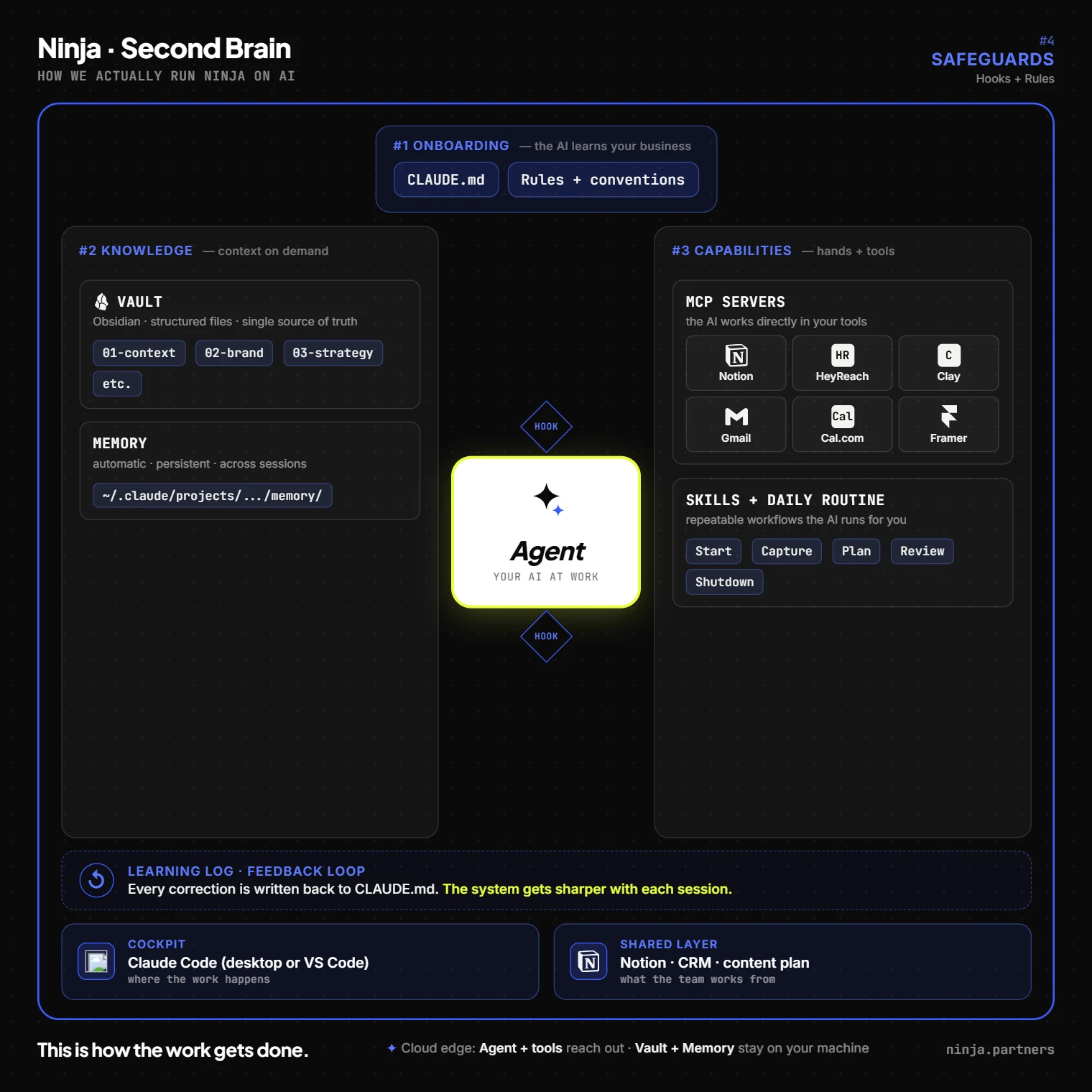
Where a second brain lives
Because a second brain is just plain files, you own them, you can read them, and you can move them anywhere. They usually live in one of two homes. The private one is a local vault of markdown notes on your own machine, opened in an editor like Obsidian. That is exactly what the free Ninja Second Brain is, and nothing in it leaves your computer. The shared one is a workspace like Notion, for when a team needs to see and edit the same context in the browser.
We run both. The thinking and the source of truth sit in a local vault, the parts the team works from live in Notion, and Claude reads and writes across the two. The app matters less than the habit underneath it: your AI has to read from the brain and write back to it.
Why context beats capability
The companies getting a real return from AI did not find a smarter model. They fixed the wiring around it. We went into that in detail in why companies spend more on AI than it returns: AI bolted onto an unchanged process, with no owner and no memory, entrenches the mess rather than clearing it.
An architect does not draw a new house from a blank sheet every morning. She works from plans and details she trusts. A second brain is that set of plans for your AI.
Context is the same story at a smaller scale. A model with your full context and a plain instruction beats a better model guessing in the dark. Capability has been abundant for a while now, and it keeps getting cheaper. Context is the scarce input, and it is the one thing you own that a competitor cannot buy off the shelf.
For me this is a quiet reason so much AI spend returns so little. The budget flows to capability the market has already commoditised, and skips the context only you can supply.
What it looks like day to day
A second brain is not a document you write once and forget. It is a habit the system carries for you.
You open the day and it tells you where things stand. You capture thoughts as they arrive and it files each one where it belongs. You plan a project and it drafts from your context, in your voice, not in the flat house style of a generic assistant. You close the day and it logs what moved, so tomorrow does not start cold. Correct it once and it writes the lesson down, so it stops making the same mistake. The longer you use it, the more it sounds like your business rather than everyone's.
None of this needs a new subscription. It needs a place for the context to live and a tool that can read and write it. We run Ninja on exactly this. Our strategy, our campaign data, our client workspaces and the site you are reading all live in one system that Claude reads from and writes to. That is not a case study we went looking for. It is how the work gets done.
Start with what you already have
You do not need to buy anything to begin. Pick one corner of the business, write down the context an assistant would need to be useful there, and let your AI work from it for a week. The distance between generic output and something you can actually send is almost always the context you gave it, not the model you paid for.
To make that first step easy, we packaged the exact system we run Ninja on into a free, ready-to-run Second Brain. You open it in Claude Code, answer three questions, and it builds itself around your business.
And if the deeper question is where AI is genuinely worth the spend in your business, that is what an AI Readiness Audit is for: a senior-led read of where it would pay off, what to leave alone, and what it would actually cost. No pitch deck, no tool you did not ask for.
Sources
- 56% of CEOs see no revenue or cost gain from AI - PwC 29th Global CEO Survey, January 2026, via Forbes.
- Mid-market runs several AI tools, only about a third with consistent governance (directional, vendor survey) - Freshworks, "The Global Cost of Complexity Report", 2026.
Get the Ninja Second Brain, free
The exact system we run Ninja on, packaged and ready to run. Open it in Claude Code, type /setup, and it builds around your business. The newsletter is a separate, optional choice.
Frequently asked questions
What is a business second brain?
A single place where your business context lives: who you are, what you sell, how you talk, your standards, your live projects and the decisions behind them, written so your AI can read and work from it. Instead of re-explaining the business every session, the AI starts from what you already know.
What is a business second brain made of?
Five plain parts working together: memory (a context file your AI reads first), structure (your files organised so both you and the AI can navigate them), MCP (connections to your tools so the AI can act, not just chat), skills (saved instructions for work you repeat), and a routine (a short daily loop of briefing, capture and review). Each part does a specific job, and together they let your AI work from your business instead of from nothing.
How is this different from ChatGPT or a note-taking app?
A note-taking app stores notes for you to read. A chatbot answers a question and forgets it. A second brain sits between the two: your AI reads and writes to it, so your context is reused on every task rather than re-entered each time. The value is not the notes, it is that the AI works from them.
Do I need to be technical to set one up?
No. The free Ninja Second Brain runs in the Claude desktop app with no terminal and no code. You open a folder, answer three questions, and it builds the structure for you. If you can write a sentence, you can run it.
Is my business data private?
The system lives on your own machine, not on our servers. How Claude handles your data depends on your Claude plan and settings, which the included guide explains. For anything touching customer data, a Team or Enterprise plan keeps it out of model training.
Where do I start if AI already feels generic and expensive?
Before adding another tool, look at the context you are giving the one you have. If you want an outside read on where AI is actually worth the spend in your business, an AI Readiness Audit maps where it would pay off, what to leave alone, and what it would cost.

Kerstin Dallinger
AI Trainer & Strategist, Ninja Partners
Legal Counsel by training, AI strategist by choice - the non-developer who ships real AI systems daily. Designs the websites, smart funnels, and agentic automation behind Ninja's growth - systems she scopes, builds, and runs herself.
Connect on LinkedInWant the next article by email? Get the Ninja Partners newsletter, one or two emails a month on AI, marketing and growth.
Not sure where your AI spend is leaking? Start with the AI Readiness Audit.
A senior-led diagnostic of your tools, workflows and data - a prioritised plan for where AI pays back, what to leave alone, and what it will actually cost. No pitch deck.
Keep reading
All articles
Self-Hosted AI for Business: 3 Ways to Run AI Yourself
Self-hosted AI gives you control over data and cost, but it doesn't make you compliant on its own. Three ways to start, what each costs, and how to test first.
Read article
Answer Engine Optimization: A Practical Guide for B2B
Buyers ask AI assistants before they ever reach your site. What answer engine optimization actually is, what measurably works, and where to start.
Read article